The Health page
Whether the installation keeps up: its services, its queues and its workers, live.
This page is for self-hosted installations. On GoRunner Cloud, GoRunner runs this for you.
In Platform, under Installation, open Health. It reads every 10 seconds while open, and says Live. It is for instance-wide platform admins.
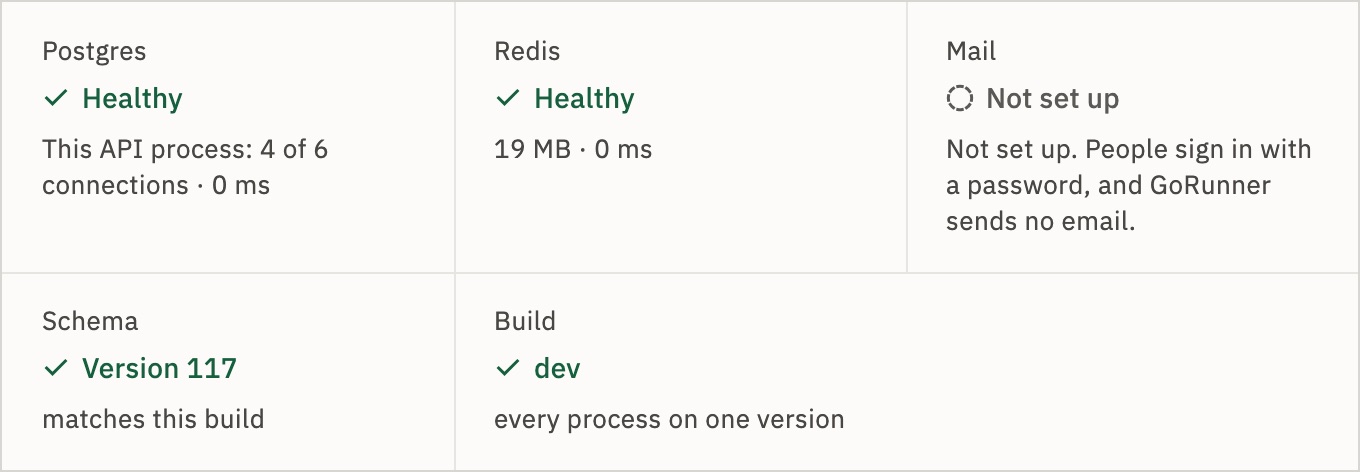
Services
- Postgres
- Whether it answers, and this API process’s connections in use.
- Redis
- Whether it answers, and its memory. It warns from 70 % of
maxmemory: at the limit, Redis refuses new writes, so new runs wait instead of starting, schedules don’t fire and sign-in fails until memory is freed. “Can delete keys when full” means it isn’t set tonoeviction. - Object storage
- Whether the bucket answers, with your own or built-in storage.
- Who sends, or “Not set up. People sign in with a password, and GoRunner sends no email.”
- Schema
- The database’s version, and whether it matches this build.
- Build
- Whether every process runs one version. During an update it reads Mixed.
Over time
Four charts over 1 hour, 24 hours or 7 days, all at the same moment: Longest wait to start, Waiting runs, Workers live and Busy slots. A wait over 2 minutes counts as behind.
Who is waiting names the organizations whose runs wait, and why: a free worker slot, their runs-at-once limit, or a time later on.
Queues and dead letters
Queues shows Workflow runs, Editor test runs and Keel: waiting, running, the oldest wait, and how many start a minute.
Dead letters are runs that never reached a worker. A run also lands here when its worker stops three times; it is already failed. Clear… removes them without running them, and asks for your code.
Background jobs
Each says On time, Late, Failed or Not yet, and when it last ran.
| Job | What it does | Every |
|---|---|---|
| Schedules | Starts scheduled runs on time. | 1 min |
| Polling triggers | Checks polled apps for new items. | 1 min |
| Re-dispatch | Hands waiting runs to workers again. | 10 s |
| Stuck-run recovery | Gives a lost run to another worker. | 10 s |
| Run close-out | Closes runs whose worker is gone for good. | 10 min |
| Timed resumes | Wakes runs that waited for a time or an answer. | 5 s |
| Log flush retry | Saves run logs that couldn’t be written the first time. | 1 min |
| Run data cleanup | Deletes run data past its keep time. | 1 h |
| Audit cleanup | Deletes audit rows past their keep time. | 1 h |
| Restore deadlines | Removes deleted customer accounts once their restore window ends. | 1 h |
| Notification events | Collects the events sent to your server. | 15 s |
| Notification delivery | Sends your server its events, and retries. | 5 s |
| Usage rollup | Counts runs per organization per day, for the charts. | 5 min |
| License notices | Emails platform admins before the license ends. | 5 min |
| Payload cleanup | Deletes stored step data that nothing needs. | 15 s |
| Health samples | Writes one sample a minute for Health’s charts. | 1 min |
| Visit limits | Ends staff visits at their limit or after an hour idle. | 1 min |
A job an installation may not use shows only once it has run: run data and audit cleanup, restore deadlines, the two notification jobs, and license notices (only with mail).
Processes
One row per API and worker process: its host, role, version, last heartbeat, and busy slots or database connections.
What do I do when the queue is behind?
The verdict at the top names the cause. Every slot busy means runs arrive faster than workers finish them: add workers, or raise WORKER_CONCURRENCY with the workers’ memory. No worker live means nothing runs until one reports.
Related
- Health checksThe addresses a load balancer asks
- MetricsThe same figures, in your own tool
- Several serversMore workers · 15 min
Checked against 12d85b3b